Building The Family Nest.
March 3, 2026
There is a Chinese adage that says, “Fish should not stray too far from where they live.” This is a guiding light for the immigrant generation and for the public, private, and nonprofit sectors that foster the conditions for community sustainability. Stability grows from continuity, and progress comes through shared problem-solving and adaptability—both are rooted in working within one’s natural domain and building on experience.
Our last communication on Flow Funding empowerment highlighted the need to understand better the intersection of the formal and informal sectors in advancing a community’s sustainability. Discovering these invisible forces of change-making enables us to identify the people and activities that facilitate the complementarities between these two sectors. We’ve found that a map of what makes up the sustainability of a community is an invaluable guide for those inside and outside the neighborhood in helping to cross-pollinate and reinforce one another’s growth and development. This newsletter provides an introductory glance at that map—which shifts focus from our ongoing efforts in the Chinese diaspora of the Tenderloin to a new study of San Francisco’s Chinatown. The data supporting the map are rich, and we look forward to sharing more of what we’re learning in upcoming newsletters.
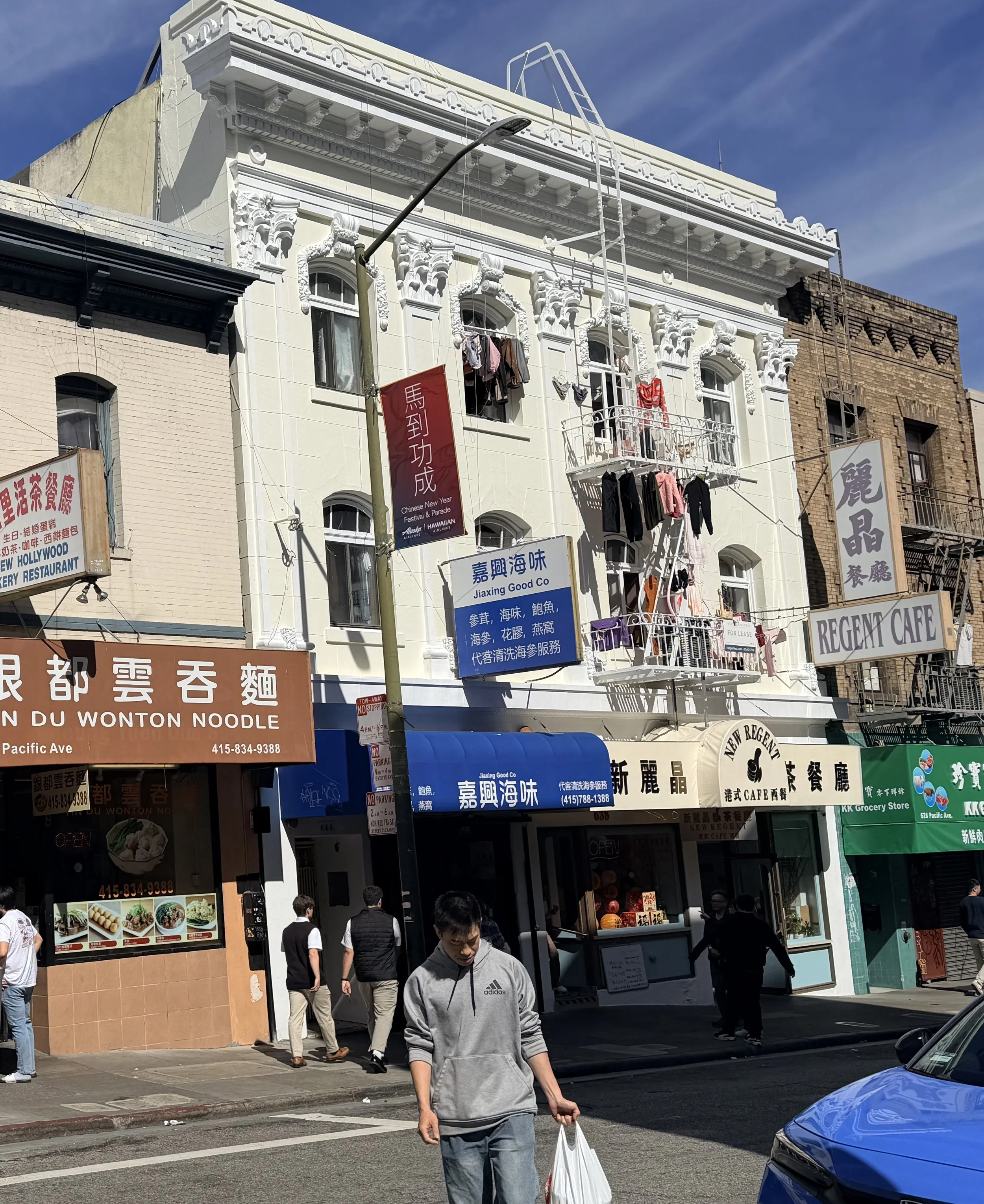
In the summer of 2025, we began our explorations in partnership with the SRO Family Collaborative, the Chinatown Community Development Center. We conducted a door-to-door survey of 118 buildings and received just under seven hundred responses. Most of the buildings are SROs (single-room occupancy; typically, 330 to 500 square feet, with shared bathrooms and sometimes kitchens). See below the map of the survey locations (in green) in Chinatown.
An SRO building in San Francisco’s Chinatown.
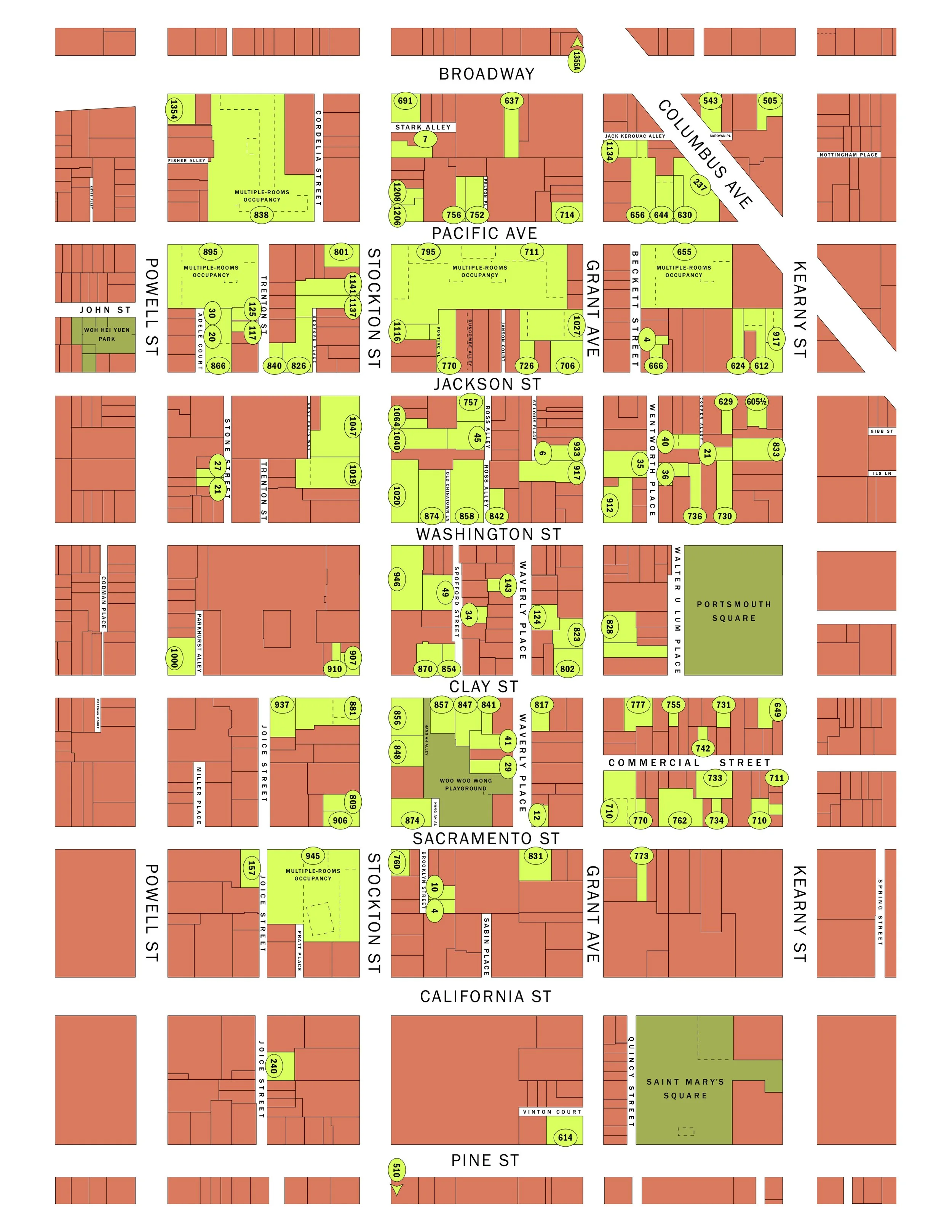
The survey map of the Chinatown neighborhood was designed by John Borruso.
The median age of those who responded to the survey was sixty-seven; 70 percent were women and 30 percent were men. Ninety-nine percent of the respondents were born in China, and a large number of them were born in a Taishan rural county, Jiangmen prefecture, Guangdong province. Given the age of the survey respondents, we project that most of them came to the United States during or shortly after the collapse of the Great Leap Forward campaign (1958–1962) in China. The collapse led to national economic decline and mass famine throughout China. (For additional information about the Great Leap Forward movement, see https://en.wikipedia.org/wiki/Great_Leap_Forward.)
Knowing the current building arrangements, living conditions, and historical background of the survey respondents, we wanted our study in part to uncover their “North Star”—the guiding aspiration—and the pathways they pursued in trying to realize this common goal in San Francisco’s Chinatown. Perhaps not surprisingly, one of the key findings of our study was that the residents sought to build a caring and lasting family “nest” in a customary habitat. The following is a brief summary of what we are learning about how immigrant families are self-motivated and going about building their nests in San Francisco’s Chinatown.
Working Harmoniously Together and Solving Daily Problems
Ninety-three percent of the survey group (621 residents) praised their extended family blending differences together when solving problems. Problem-solving is a sure way to adapt and grow and develop the extended family as a social unit of change. Spouses, children, relatives, friends, and community/spiritual leaders make up 86 percent of the group involved in coming together to help one another. We are identifying local talent, skills, and methods that surfaced from the 254 respondents (38 percent) who have indicated the extended family and their friends as being able to solve the problems facing them without help, as well as the 367 residents (55 percent) who are working harmoniously together but indicated that they need help from outside the resources of the extended family.
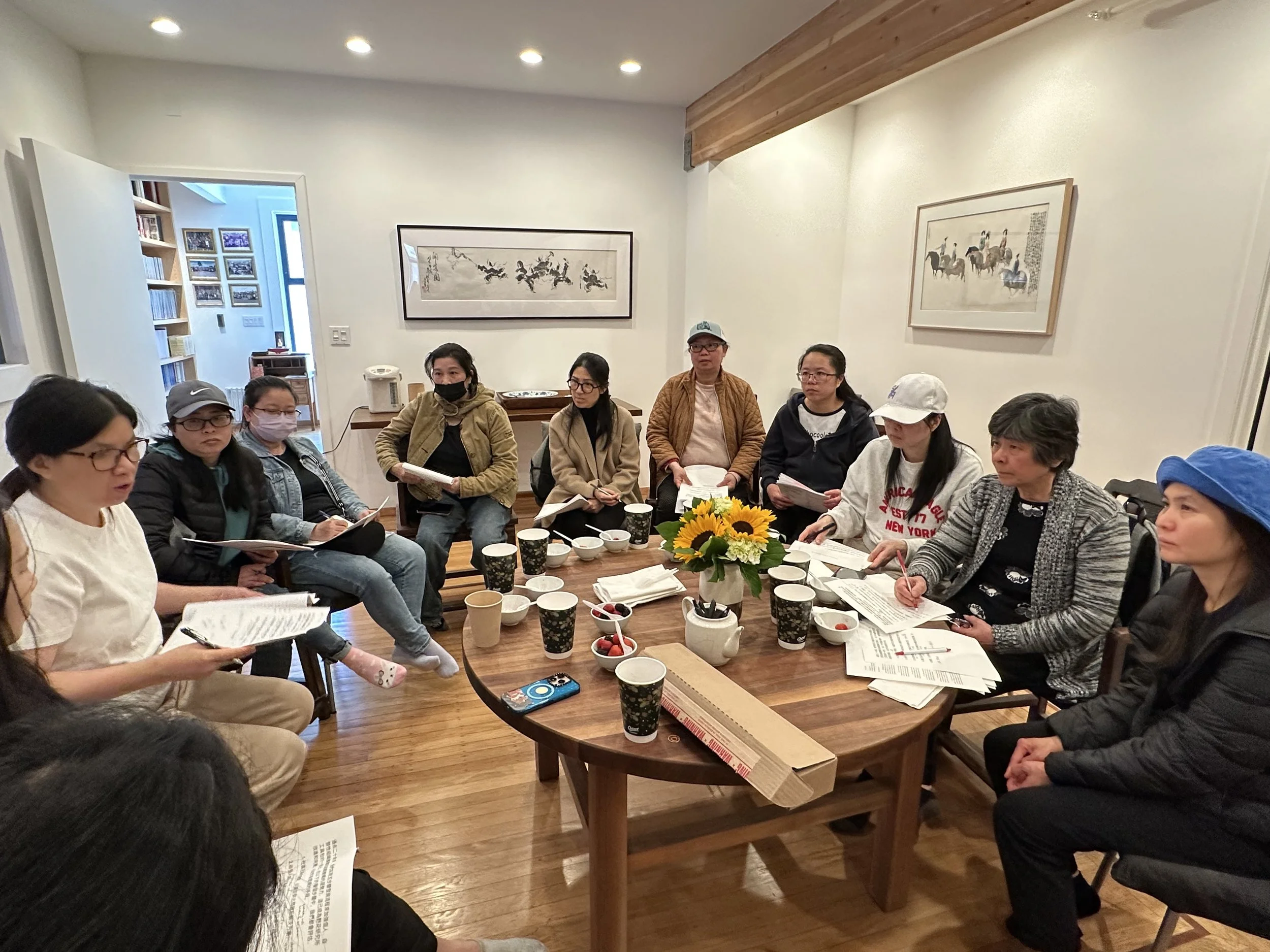
Members of the SRO Family Collaborative who conducted the survey in Chinatown.
The Kitchen Table Is a Spiritual Refuge for the Extended Family
We define spiritual refuge in our survey as “a place where every member of the family can freely come and go as they please. A place where the family feels more stable, connected, and undisturbed being together.” We have identified 140 residents living in thirty-seven addresses in Chinatown who stated that the kitchen table is their spiritual refuge. We and our partners will be learning from these residents in selected buildings about how the family works together in preparation for and during a meal, what makes the meals special to the family, and the ways in which the life at the kitchen table fosters care for others. We have also begun to identify impediments to flourishing kitchen tables.

Chinese family members gathered for a meal in their SRO residence.
A Safe and Protected Habitat for the Extended Family
Owing to public, private, and nonprofit organizations actively reducing structural obstacles for tenants, 95 percent of the survey respondents (634 residents) live in affordable single-room occupancy dwellings and some in multiple-room housing. Moreover, 635 respondents out of 660 (95 percent) feel they and their neighbors protect and safeguard one another. And about 97 percent of residents shop for most of their groceries in Chinatown. Furthermore, 75 percent of the survey respondents call out local parks and coffee shops for maintaining their sense of social belonging and for weaving a social fabric among one another.
Building on What Works
Inside-out transformation emerges from dwelling within one’s natural domain, and from building upon this wealth of experience. By learning more about what works, we can identify additional local assets and resources that strengthen and advance the residents’ goals in life. The cornerstone of Flow Funding is to build on both what already works—and the motivation and moral spirit of the community advancing from one generation to the next. Flow Funding will go to supporting projects related to the kitchen table serving as a sacred space; to the family solving problems harmoniously and successfully; and to improving the safety and protection of the social, cultural, and environmental habitat. Funding will also target cross-pollination projects that bring the informal and formal sectors together.
Our Flow Funding empowerment will continue to build on the foundation of wisdom already present in the community. When we do the math focused on the median age of the survey participants (sixty-seven years old) and multiply these years by the number of survey respondents (660 individuals), we come to 44,220 years of experience in building a family nest! Our findings and work illuminate the adage that “Fish should not stray too far from where they live,” even as we work to unleash and build on the rich experience of Chinatown’s residents.