Cooperative Planning and Polling Residents: The Secret Sauce
June 25, 2026
When our studies revealed that 87% of Tenderloin residents and 95% of Chinatown residents reported their feeling protected and safeguarded where they live, we asked ourselves how are they making this happen? There are different regions, provinces, counties, and dialects in China and in Asia from which residents have migrated. There exists no common written or oral language among the Chinese diaspora in San Francisco.
In this report, we describe our journey and approach to discovering the answer to our question as we now engage in cooperative planning with residents of Maria Manor in the Tenderloin and of Chinatown single-room occupancies (SROs). Our aim is to help strengthen the community’s will to interact with and help one another. We collaborate with residents and those who are grounded in the daily reality of the neighborhood. They are effective because they know what to support and who is ready to act. To this end, our focus is on what moves and motivates neighbors and friends to support one another. How do things work for the good of the commons? This approach channels the learning from our community studies alongside a belief in the fundamental value of a community's capacity for deliberative, democratic dialogue.
We have now surveyed more than 2,000 neighbors in San Francisco's Chinatown and Tenderloin. All our studies are organized by residence locations. From our survey of 118 locations in San Francisco Chinatown, we learned that the overwhelming majority of the residents feel safe and protected. We took a closer look at the survey data and identified eleven buildings where 98% of the residents also indicated that their family and members of their community work harmoniously together and solve daily problems successfully. To learn more about the "secret sauce" that fosters guardianship and harmony, we made arrangements to visit one of the eleven living quarters.
This SRO residence has rooms of roughly 50 to 115 square feet and a shared community kitchen and bathroom on each floor. We met with three residents in their community kitchen, which many in the building see as their family spiritual refuge. The size of the kitchen is about 115 square feet. On one side is a convection stove and on the other side is an empty table for preparing and placing cooked dishes. The table extends from one end of the room to the other. There are no storage cabinets and no refrigerator.
To help us understand how they cooperated to make things work, they described their use of the stove with the residents on their floor. They told us in a matter-of-fact manner that most of the residents are quite sensitive about the needs of others and are aware of their preferences on when they must use the stove. Without any one person or group taking charge of or being responsible for a schedule for using the stove, the residents become aware of and sensitive to who needs to cook and eat at what time. What the residents also shared with us was their frustration with the newcomers in the building; they are not of Chinese origin and are oblivious to the self-organized schedule for the use of the stove. Newcomers are cooking on the stove and leaving dishes on the table whenever and however they choose. This continues to be a disruption to an intrinsic and organic manner of cooperating together.
Soon after our site visit, we conducted a literature review to name the thread that generated the formation of community to work harmoniously together and to protect their social order. Our research uncovered an enduring code of honor, li (禮); see endnote 1. Joseph Needham, the eminent Cambridge University scholar of China, wrote that this code had emerged during the Zhou dynasty (1030–221 BC) and is very present today among Chinese diaspora communities. Needham described the attributes of the code as “duties, compromise, and unselfishness in the interests of harmony”; see endnote 2. According to Needham, this code is “the sum of the folkways whose ethical sanctions had risen into consciousness”; see endnote 3. “Yet the fluidity of li retained for centuries so much of its original social prestige, and was so much more in accord with the general trend of Chinese philosophy . . . that even after bureaucratism had long been solidly established, the former dominated over the latter”; see endnote 4.
Furthermore, Needham draws upon the work of Chinese scholars to illuminate the profound meanings of “unselfishness in the interests of harmony“ (理); see endnote 5. He cites the observation of Hu Yin (1093–1151): “That which every right-minded man has in common with others is called the pattern of human-hearted behaviour”; see endnote 6. Needham, who studied the works of Chu Hsi (1131–1200) and considered Chu Hsi to be “the supreme synthetic mind in all Chinese history” (see endnote 7), came to define unselfishness in the interests of harmony as “a dynamic pattern as embodied in all living things, and in human relationships and in the highest human values”; see endnote 8. Needham offered further clarity on the meaning of human-hearted behavior when he referred to Chu Hsi speaking of “love . . . as the motive force of all things . . . [and] tender-heartedness and love are part of the very essence of [a person’s] life”; see endnote 9.
With this understanding of a code of honor and a moral principle of love and tender-heartedness as a salient motivating force of being and working together, we felt that we now have a deeper understanding of and are now ready to cooperate with the residents at Maria Manor and codevelop a plan with them. The institute’s 2025 survey of Maria Manor reached out to 80 of 110 residents. Ninety-five percent of the respondents were born in different regions of China and 5% were from different countries in Asia. There is no common dialect and language among the residents. Sixty-five percent of them live alone; 72% are female and 28% are male. The median age is 79 years old.
Our survey at Maria Manor reveals that even though barriers exist in oral and written communication, what they do have are shared aspirations and time-tested pathways in the building of their personal, family, and social nest across differences. As noted above, 87% of the residents feel safe and protected. In addition, residents reported the following:
70% have a place where their friends and neighbors can get together almost any time;
90% have formed a spiritual family refuge in their one-room living space;
69% have dinner with family/friends most of the week or on one or both days of the weekend;
86% report their family and/or members of their community working harmoniously together;
96% primarily of extended family members and friends and community/spiritual leaders help residents solve daily problems;
95% of the extended family, friends, and spiritual/community leaders help the residents heal; and
63% indicated that a friend and/or relative offered them a gift gesture that they did not ask for or expect.
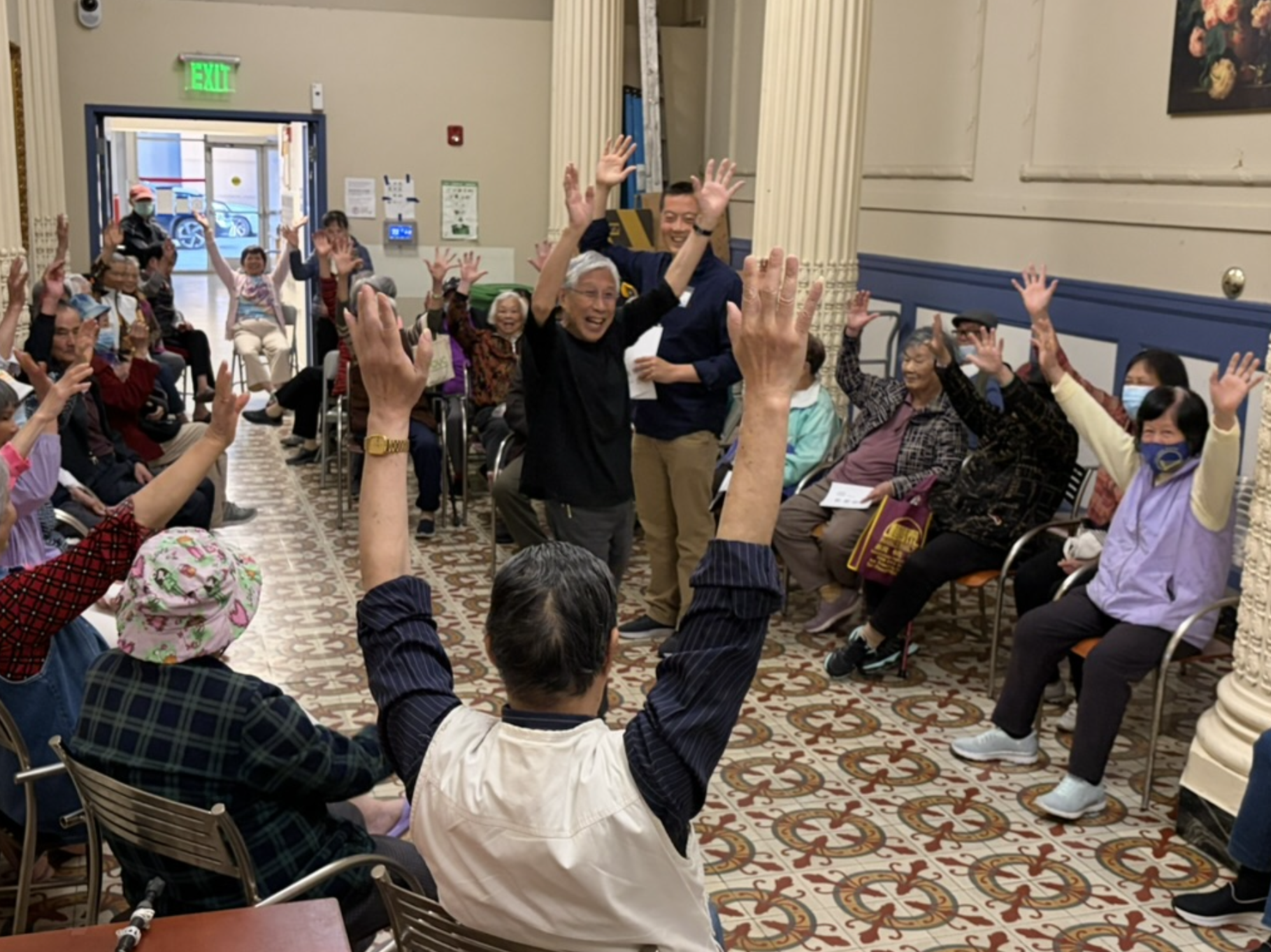
At our first of three community meetings with the residents of Maria Manor, we asked the residents their definition of li and was li important to them. We shared copies of the traditional Chinese character li, the code of honor and the pattern of human-hearted behavior, along with Needham’s definition of them. We asked residents to raise their hands if this moral principle and code of honor resonated with them. See the photo below of their enthusiastic response.
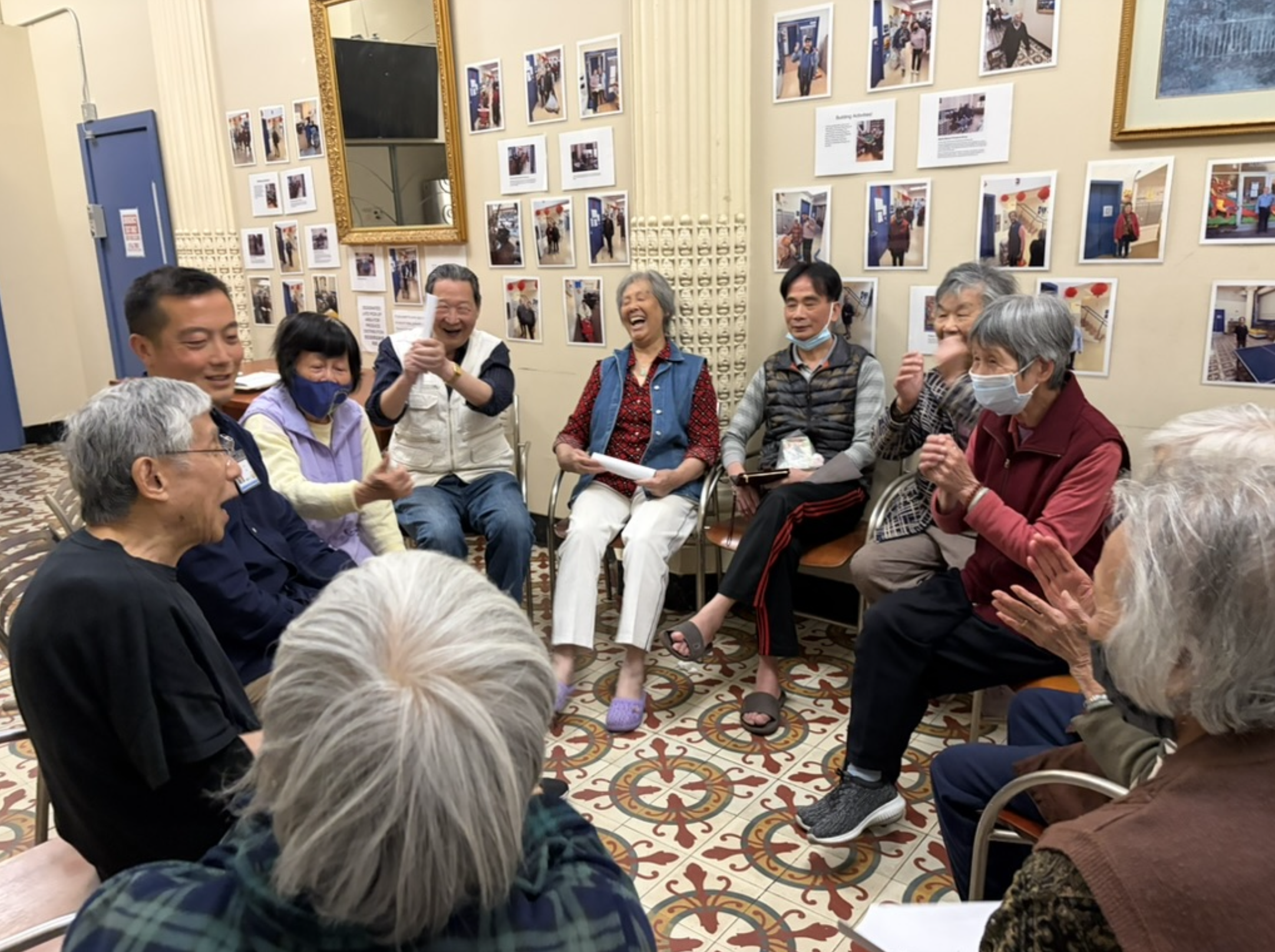
At that moment, we felt certain that we were grounded, not in our own mind's eye but in the eyes of the elders and residents of Maria Manor. The process of cooperative planning is being developed by discovering what works in building relationships and in strengthening the good of the commons. It is a process of trust-building and discernment. At subsequent community meetings, residents spoke spontaneously and emotionally about what activities will help strengthen their relationships and their social formation. The photo below shows a cluster of informal leaders discussing activities for the residents in their building.
The informal leaders suggested four activities to be voted on by all the residents in the building. We added a fifth choice, "other," to be sure we heard from all the residents. The five choices are:
Group outing to Golden Gate Park or another nature, art, or cultural destination;
Games and fun activities;
Social hour with coffee, tea, pastries, and conversation;
Shared community meal celebrating a cultural holiday or tradition; and
Other (please describe)
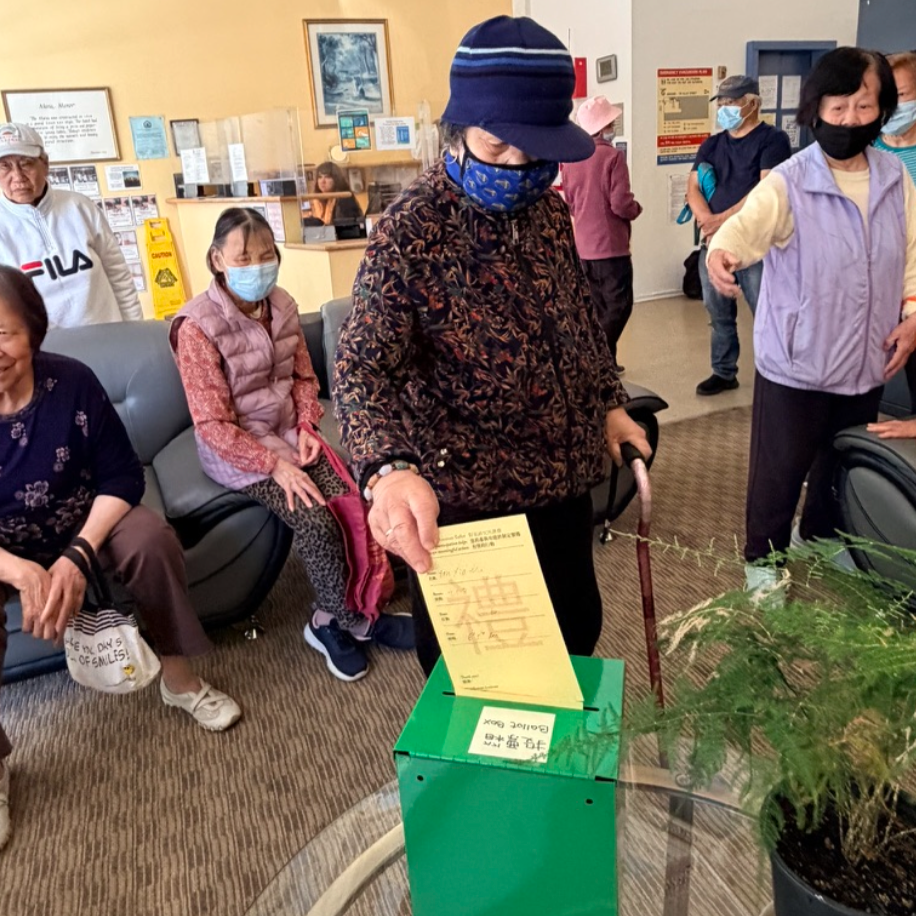
Based on these recommendations, the institute printed 110 ballots seeking the residents’ thoughts on the project that will help them the most. The ballot invited residents to vote on what makes the greatest difference in nourishing loved ones and in building stronger, healthier relationships among neighbors and with family members. Their vote is equal to a $25 gift that Wildflowers will give to the project activity that they choose. The photo below captures one of the residents dropping her ballot in the institute's ballot box.
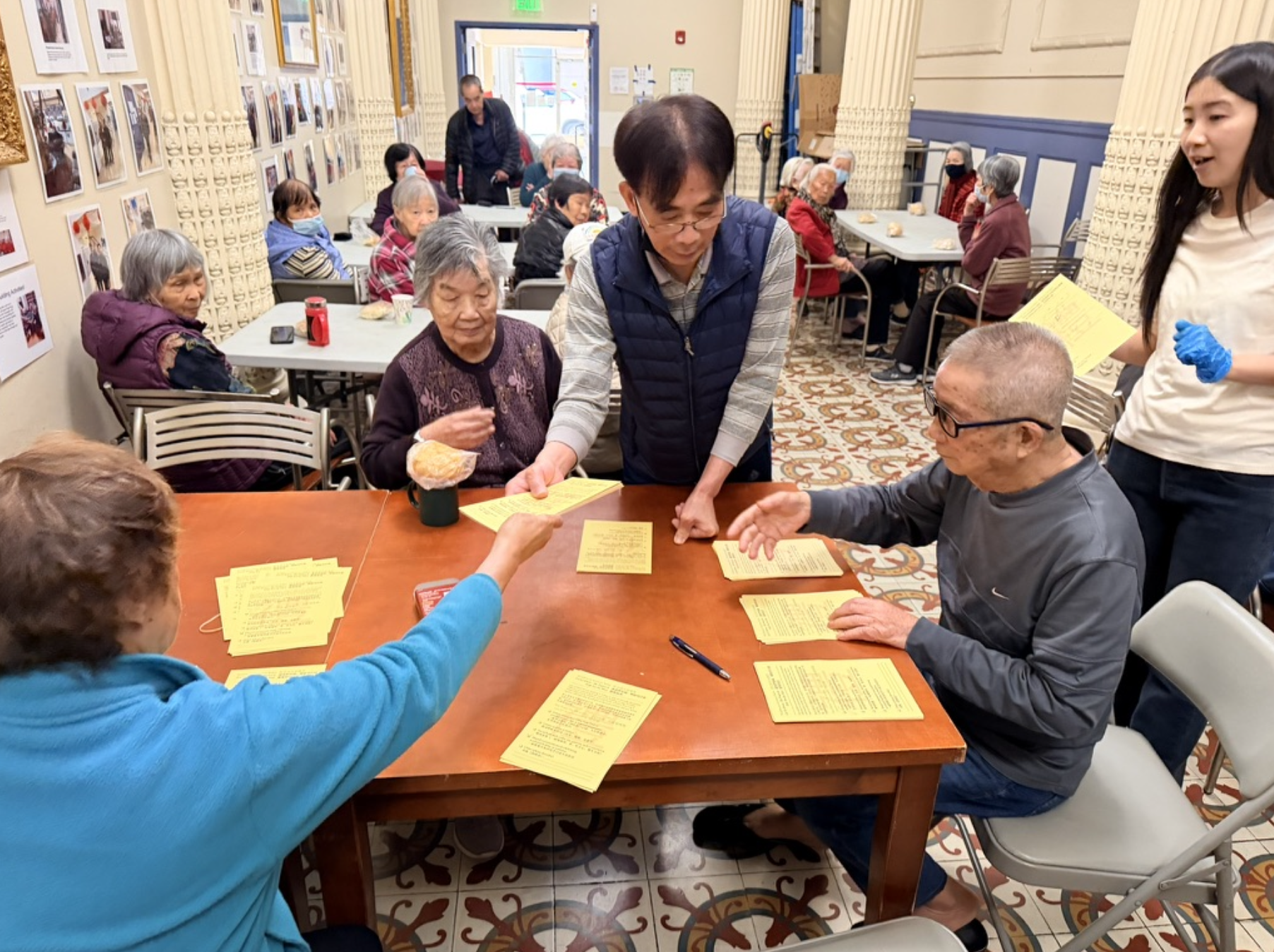
On June 16, 2026, a group of 25 residents participated in tallying the votes as shown in the photo below. They determined that 91 residents had voted and decided on funding the activities in the following manner:
Social hour and conversation ($1,075)
Group outing ($700)
Games and fun activities ($275)
Shared community meal ($225)
Other (no dollar amount)
In summary, the primary purpose of cooperative planning and the polling of residents is to elevate the collective will of the people to work together voluntarily to address the problems they face and in a manner most suitable to them. The secret sauce is nourishing the knowledge of and flowing with the community's pattern in human-hearted and moral behavior.
Endnotes
See Joseph Needham, Science and Civilisation in China, Volume 2, History of Scientific Thought (Cambridge University Press, 1956, page 530). The Chinese character li (禮) is pronounced “lee.”
Ibid., page 532, footnote c.
Ibid., page 544.
Ibid., page 531.
The Chinese character li (理) is also pronounced “lee.”
Ibid., page 411.
Ibid., page 458.
Ibid., page 558.
Ibid., page 488, and footnotes 6 and 15.